Showing posts with label Cullom Gallery exhibit. Show all posts

Thursday, May 24, 2012

Hatchings Highlights

With just two weeks to go, I want to thank everyone for the great response we've had to the Hatchings series these past three months.  I have been pleased to have Rumi Koshino, Robert Hardgrave, and Brian Lane as guest curators for the run of these shows.  Their artistic vision has brought a new selection of art, artists, and their fans to the gallery, and has allowed me some valuable time with our new daughter, Summer, who was born at the end of March.  A big thanks to these three talented artist curators.

Below are a few highlights from the three shows.  And a reminder that Brian Lane's exhibit, Texture of Being, continues at Cullom Gallery through June 2nd.  Then it's back to work for me, and an exhibit of Eva Pietzcker's woodcuts of Washington State, opening June 7th.  


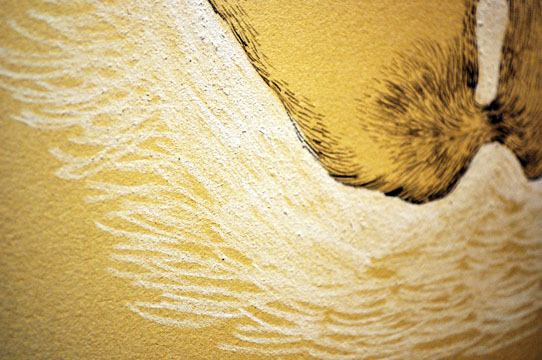
Gala Bent.  detail from Inverted Mountain 3. Graphite and pigment on paper.
Courtesy G. Gibson Gallery. From the exhibit, Open Interval, curated by Rumi Koshino,
on view at Cullom Gallery, March 1 - 31, 2012

Gala Bent.  detail from Inverted Mountain 4. Graphite and pigment on paper.
Courtesy G. Gibson Gallery. From the exhibit, Open Interval, curated by Rumi Koshino,
on view at Cullom Gallery, March 1 - 31, 2012.


D.W. Burnam. detail from Nathaniel's Incredulity. Ink on paper ; 8-1/4 x 9-1/2 in. 2012.From the exhibit, Open Interval, curated by Rumi Koshino, on view at Cullom Gallery, March 1 - 31, 2012


Garek Druss.  detail from Beyond Perfect Listening. Watercolor, pen, and graphite on paper. 6 x 4 in. 2012.From the exhibit, Open Interval, curated by Rumi Koshino, on view at Cullom Gallery, March 1 - 31, 2012


Peter Taylor. The Angler and the Little Fish, 2012. Graphite on paper. 17 x 14 in. From the exhibit, Refable: Graphic Works Inspired by Jacob Lawrence and His Renditions of Aesop’s Fables, curated by Robert Hardgrave, on view at Cullom Gallery, April 5 - 28, 2012.

Hibiki Miyazaki. The Donkey in Lion’s Skin, 2012. Mixed Media. 20  23-1/2 in. From the exhibit, Refable: Graphic Works Inspired by Jacob Lawrence and His Renditions of Aesop’s Fables, curated by Robert Hardgrave, on view at Cullom Gallery, April 5 - 28, 2012.
 
Robert Hardgrave. Amphibious, 2012. Ink on paper. 21-1/4 x 18-1/4 in. From the exhibit, Refable: Graphic Works Inspired by Jacob Lawrence and His Renditions of Aesop’s Fables, curated by Robert Hardgrave, on view at Cullom Gallery, April 5 - 28, 2012.


Matthew Dennison. Bundle of Sticks, 2012. Ink on paper. 10 x 12 in. From the exhibit, Refable: Graphic Works Inspired by Jacob Lawrence and His Renditions of Aesop’s Fables, curated by Robert Hardgrave, on view at Cullom Gallery, April 5 - 28, 2012.


Annie Bissett.  Sometimes I'm Married, 2010. From a series of 5 moku hanga woodcuts. 6 x 8 in. each.  From the exhibit, Texture of Being: Human Experience in Relief Prints, curated by Brian Lane, on view at Cullom Gallery, May 3 - June 2, 2012.

Michelle Martin.  Observation #25, 2007. Reductive linocut. 15 x 20 in. From the exhibit, Texture of Being: Human Experience in Relief Prints, curated by Brian Lane, on view at Cullom Gallery, May 3 - June 2, 2012.
Charles Spitzack. Self Portrait, 2009. Sosaku hanga woodcut. 12 x 9 in. From the exhibit, Texture of Being: Human Experience in Relief Prints, curated by Brian Lane, on view at Cullom Gallery, May 3 - June 2, 2012
Brett Anderson. Promethean Truth & Glamour, 2011. Reductive woodcut.  20 x 15 in. From the exhibit, Texture of Being: Human Experience in Relief Prints, curated by Brian Lane, on view at Cullom Gallery, May 3 - June 2, 2012

Friday, March 9, 2012

Spring Hatchings

In preparation for a few months off with our new baby, who is expected in early April, I have turned over Cullom Gallery's curatorial work to three Seattle artists who I have had the pleasure of getting to know over the past few years.  In what we are calling the HATCHINGS series, I have invited these artists to each curate a show of works on or of paper, and in crafting their shows, lead with their own knowledge, interests, and connections.  Though at its heart, Cullom Gallery looks at the connection between Japan and the West through traditions of paper arts, there was no requirement that these curators connect to any part of that narrative.  I stressed that my only curation in the project was the selection of the three of them.  The rest would be whatever they came up with.

For me the process of "hatching" this series of exhibits has been another positive reminder of the 'letting go' refrain that is such a part of preparing for parenting.  I am deeply grateful for the commitment these talented artists and curators have given me.  They have embraced the concept of these exhibits and really run with it, allowing me time and space to hatch in other ways.  And as the exhibit release describes, these three diverse shows also "explore personal, artistic, and textural hatchings and cross hatchings."

Curator of the April HATCHINGS exhibit, Robert Hardgrave, designed the sumi ink design below to illustrate the series postcard and poster.  The shape of the image was intended to represent the intentions of the exhibit series: a texture of drawn hatching marks, and a five sided form representing the five of us involved - one gallerist, three curators, and one baby-to-be.  

All HATCHINGS shows will be up on Cullom Gallery's website.  Openings are on the first Thursday of each month from 6 to 8 pm.  More on each show to come in the following days and weeks.  


HATCHINGS March - May, 2012
Three Exhibits Curated by

Rumi Koshino - Open Interval, March
Three Seattle artists use visual form as part of their non-visual practice as writer (D.W. Burnam), mother (Gala Bent), and musician (Garek Druss) in works on paper. 

Robert Hardgrave - Refable, April
Twelve black and white works by notable Northwest artists based on Jacob Lawrence's classic renditions of Aesop's Fables.

Brian Lane - Texture of Being, May
Seattle's Print Zero Studios founder dips into his pool of local and national woodcut artists to explore facets of personal experience and the dream world.

Friday, September 30, 2011

Cutting Edge: Paper Cuts by Ryohei Tanaka & Qiao Xiaoguang

This month and through October 15th Cullom Gallery is showcasing the work of two contemporary paper cut artists: gallery favorite and Tokyo native, Ryohei Tanaka; and Beijing-based Chinese artist Qiao Xiaoguang. The exhibit, Cutting Edge: Contemporary Paper Cuts by Ryohei Tanaka and Qiao Xiaoguang, offers two decidedly different takes on contemporary paper cutting from two cultures with deep roots in paper cutting traditions.  Below are a few installation shots.  You can also see the complete online exhibit hereTomorrow, October 1st, Qiao Xiaoguang's Beijng gallerist, Jan Leaming, will give a talk at Cullom Gallery at 2 pm.  Jan will offer insights into the rich history of paper cutting in China, the role of mythology and folk art in Professor Qiao's paper arts, and the future of contemporary Chinese folk art.  More on Jan's talk and other US events for Professor Qiao coming soon.
Qiao Xiaoguang (b. 1957)  (left) Food Recipe (right) Humans and Animals
Qiao Xiaoguang (b. 1957) several paper cuts from Qiao's Urban Landscape series
Ryohei Tanaka (b. 1977) Cutting Edge... Installation view
Ryohei Tanaka (b. 1977)  (left) Iroha (right) The Myth

Monday, May 23, 2011

What's So Japan About It?

During the month of May, in conjunction with Cullom Gallery's current exhibit, East by West (highlighting work by eleven different artists who draw on technical and aesthetic traditions of Japanese art on or of paper) participating artists are invited to comment on the question, What's so Japan about it?" as it relates to their own work.  In the first response, Kansas City artist, Saskia Lehnert, shares her nexus of ukiyo-e, gender identity, and looking at Japanese culture from the outside in.  B.C.

Saskia Lehnert. Looking into the Sun: The Appearance of the Artist Imagining Herself as a Japanese Warrior in a Kurosawa Film. Japanese woodblock print. 22 x 15 inches.

The piece in question is a self-portrait entitled, “Looking into the Sun: The Appearance of the Artist Imagining Herself as a Japanese Warrior in a Kurosawa Film.” The image used to create this woodblock print comes from a photograph, distilled through a line screen pattern in photoshop, carved with a dremel tool in woodblock, and printed in the traditional Japanese style, known as moku hanga. This print was originally conceived as a kite print, and in fact an artist's proof from the edition was mounted and exhibited as a kite in Japan. The subject and title of the print contains many ukiyo-e references, and was originally inspired by traditional Japanese kite prints of the Edo period (1603-1868): namely the 'big head' kites such as the Daruma kites and those depicting close-up, enlarged head shots of famous actors of the day or great warriors from Japanese history. During that time period in Japan, the government under the Tokugawa Shogunate kept tight control on every aspect of people's lives, and everyone was expected to keep to a very specific place and role in society. As John Stevenson notes in the book, “Japanese Kite Prints”, during the seventeenth century, “kite-flying itself could be a mild form of rebellion against a strictly stratified hierarchy. Commoners loved to fly kites over the compounds of noble families in Edo: though not specifically forbidden, this was considered a way of thumbing the nose at social superiors.” Indeed, it was this very idea that provided the main inspiration for this print: the power of flying symbolically through the sky over the heads of society below. I decided that the 'big head' in my version of a kite print needed to be mine. Not that my ego is currently so enlarged as to need to fly above everyone else, but I felt that a bit of self-empowerment through art- making would certainly be in order for my own personal time and place in the world today.

Utagawa Kuniyoshi (1798-1861) “Mutsuki (the New Year's Festival)”. From the series, Five Festivals (Go sekku no uchi) c. 1845

The title of my print gives a nod to Yoshitoshi's famous print series, "32 Aspects of Customs and Manners (32 Aspects of Women)," produced at the end of the nineteenth century. These prints, with titles such as, “Looking sleepy: the appearance of a courtesan of the Meiji era”, or “Looking weighted-down: the appearance of a waitress at Fukagawa in the Tempo era”, depict women from various time periods in Japanese history caught in every-day moments of their lives. I adopted the naming conventions of these titles to draw a comparison between Yoshitoshi's depiction of women and my own contemporary depiction of my female self outside the Japanese tradition. Although Yoshitoshi shows a sensitivity to the women he depicts, which in my mind exceeds many of his ukiyo-e predecessors, I still hope to highlight the difference in the way his women 'look' and the way I 'look' as both the subject and the artist of this print.


Tsukioka Yoshitoshi (1839 - 1892) “Looking relaxed: the appearance of a Kyoto geisha of the Kansei era” (1789-1801). From the series: Thirty-two Aspects of Women published by Tsunashima Kamekichi, 1888
Yet not only have I muddied the gender role in this reference by 'imaging myself' into a heroic Japanese male role, unlike Yoshitoshi, it is not a role from a specific time and place in Japanese history that I take my inspiration from, but more, from my rather removed impressions of Japanese history as gathered from the movies and cultural artifacts exported from Japan, like what I absorb from watching a Kurosawa samurai film. More layers, more degrees of separation, but perhaps instead of being a romanticizing, exoticizing force, I can turn that distance into an advantage and not a disadvantage.

from Akira Kurosawa's 1954 film, The Seven Samurai

Additionally, by using myself as the subject of the print, and then imagining myself into a typical ukiyo-e subject, it gave me a chance to examine more closely my unique connection to the ukiyo-e tradition, and the ways in which it and the larger picture of Japanese artistic and aesthetic concerns inform my own work. It became a means to highlight the contradiction of a Western, American, woman artist in the twenty-first century with minimal real-life connection to modern Japan working in the tradition of Japanese woodblock prints. Also, it was a way to find the resolutions inherent in that contradiction. And so, there I am, looking heroic, looking fierce like a traditional samurai warrior. I am looking into the (Rising) Sun, both literally and symbolically; it's nebulous, it's slightly blinding, it's hard to describe what I see, but I'm still seeking to find that insight, perhaps an insight that only an outsider can bring, that only an outsider can take away. After all, the technique, content, and inspiration used in my prints exists just as much outside the ukiyo-e tradition as in it; It's quite an interesting hybrid indeed.


Thursday, March 3, 2011

Mugi Takei "I Waited A Long Time For You" Opens Tonight

We have been busy, busy installing over 120 drawings by Seattle artist, Mugi Takei, and re-purposing the closet as a screening room for her stop motion animations, which together make up the new exhibit, "I Waited A Long Time For You": Drawings by Mugi Takei, running March 3 - April 16, 2011.  The opening reception tonight, March 3rd, is from 6 to 8 pm. 

Richard Heisler, another Cullom Gallery artist, so very kindly came in yesterday and filmed some of the installation and put Mugi and me in front of the camera, then distilled it all into this short film, which gets nicely at the content and tone of the show, I think.  I am Richard's beta lab gallery as he considers making a side enterprise out of shooting films like this for gallery marketing.  More on that to come.

The web exhibit for this show will launch in stages as I do not have enough room on my current website to show all 120+ drawings at once.  The first installment will launch tonight at 6 pm at cullomgallery.com.  I hope many of you will be able to see this amazing group of drawings in person this spring.  I am very pleased and proud to be representing this talented artist!


Mugi Takei - "I Waited A Long Time For You" at Cullom Gallery March 2011 from Gallery Videos on Vimeo.

Friday, January 21, 2011

Richard Heisler | Tyler Star Opens Tonight, 6 to 8 pm

Top: Tyler Starr.  Attempted Fix: Phantom Recovery.  Mixed media with ganpi paper, gouache, and pencil on paper.  Bottom: Richard Heisler.  Roppongi #1.  Mixed media on panel.
 If you are in Seattle tonight, stop by the gallery from 6 to 8 pm for the opening party and reception for the new exhibit: Richard Heisler | Tyler Starr: Tokyo Paintings & Mixed Media Works.  Below is the press release for the show.  I hope to see you tonight!


Richard Heisler | Tyler Starr: Tokyo Paintings & Mixed Media Works
January 21 - February 26, 2011
Opening Reception with Richard Heisler, Friday, January 21, 6 to 8 pm
Artist Talk with Tyler Starr, Saturday, January 29, 1 pmBoth events are free and open to the public.

Two American artists consider contemporary views and events within Tokyo's urban neighborhoods.  Seattle artist, Richard Heisler's photorealist paintings from his ongoing series, One Hundred Views of Tokyo, quietly reference the landmark 19th century woodblock prints, One Hundred Famous Views of Edo, by Utagawa Hiroshige (1797-1858).  Selections from two of Tokyo artist, Tyler Starr's mixed media series, The Wallowing Series and Attempted Fixes, look at political, military, and municipal constructions and events in present-day Tokyo.

Heisler's dense paintings contrast with the vast empty spaces of Starr's mixed media works, yet the meticulous requirements of both artists' chosen technical approaches lead to a similar close focus on their subject. Heisler's precisely chosen layers of color and perfect lines are carefully laid in over many months; Starr applies intricatly cut layers of thin, decoupaged ganpi paper, gouache paint, and tight graphite details.  The artists' labor-intensive media draw the colors, angles, and real events of Tokyo into a sharper focus.

Richard Heisler was born in New Brunswick, New Jersey in 1973.  He was a student at Seattle Central Community College and Cornish College of the Arts, Seattle, WA.  Heisler is represented by Cullom Gallery as well as Anthony Brunelli Fine Arts, Binghamton, NY; MA Doran Gallery, Tulsa OK; and Galerie Persterer, Zurich, Switzerland.  His paintings have been shown in numerous solo and jurried group exhibits including the 2008 Biennial National Exhibiton, La Grange Museum of Art, LaGrange, GA; the 2008 Biennial Exhibition of Contemporary American Realism, Ft. Wayne Museum of Art, Ft. Wayne, IN; the CPSA Explore This 5 Exhibition, where he received the Award for Excellence; and solo exhibits at Anthony Brunelli Gallery, Binghamton, NY.  Heisler's paintings have also been featured multiple times in Southwest Art Magazine.

Tyler Starr was born in 1974 and lived in Connetiticut, Rhode Island, and Minnesota before moving to Tokyo several years ago.  In 1999, Starr was awarded a Fulbright Scholarship to study at the Academy of Fine Arts, Krakow, Poland.  He received his Bachelor of Fine Arts from the University of Connecticut, Storrs, CT, and a Master of Fine Arts from the University of Minnesota, Minneapolis, MN.  He is currently a PHD candidate at the Tokyo National Univerisity of Fine Arts, Ueno, Japan.  His work has been featured in numerous solo exhibits and jurried biennials, most recently, the International Biennial of Contemporary Prints, Museum of Modern and Contemporary Art of Liège, Belgium; the 2nd Bangkok Triennale International Print and Drawing Exhibition, Excellence Prize,PSG Art Gallery, Silpakorn University, Bangkok Thailand; and Tokyo Wonderwall 2009, Museum of Contemporary Art, Tokyo Japan.  His work is in the permanant collections of the Corcoran Museum, Washington, DC; Univerisity of Connecticut; and Pozan Museum of Fine Arts, Poland.

For more information please contact Beth Cullom, Cullom Gallery, 206-340-8000, info@cullomgallery.com.

Sunday, October 24, 2010

Annie Bissett at Cullom Gallery

I was so pleased to have Annie Bissett and her partner Lynn in Seattle for the opening of the show of her new series of woodblock prints, We Are Pilgrims.  Here are a few photos of the opening reception on October 15th, and Annie's talk and demonstration the next afternoon.  My thanks to everyone who came by.  I especially enjoyed listening to Annie's thoughts on Saturday and hearing about the historical discoveries she made over the course of the 2+ years it took to complete the suite of prints.  The complete show is up on line at cullomgallery.com along with Annie's commentary about the underlying facts behind each design.  We also have copies of Annie's very fine illustrated catalog, We Are Pilgrims.  Contact the gallery if you would like to order a copy. 


Friday, October 8, 2010

Getting Ready for Annie Bissett

We are putting the finishing touches on Cullom Gallery's next exhibit - a new suite of woodblock prints by Northampton, Massachusetts artist Annie Bissett.  Come meet the artist and celebrate the opening of this beautiful and insightful show on Friday night, October 15, from 6 to 8 pm.  (Cullom Gallery, 603 S Main Street, Seattle map).  The Gallery will also host a talk and printmaking demonstration with Annie Bissett on Saturday afternoon, October 16, at 1 pm.  Both events are open to the public.  Come and bring a friend!

Here is some information about Bissett's series, taken from our press release, and a sneak peek at a number of the prints.  We look forward to seeing many of you at the gallery next Friday night!


We Are Pilgrims is a suite of fifteen Japanese-style woodblock prints that centers on the lives of the earliest settlers of New England.  The suite is both a personal exploration of Bissett's legacy as a Mayflower descendant and a critical look at the contemporary impact of the pilgrims' arrival in America almost 400 years ago.

Annie Bissett employs the Japanese woodblock printmaking method known today as moku hanga, which is characterized by Japanese papers, water-based inks, self-carved blocks, and hand-printing, to complete the series. All prints were realized over a two year period in 2008 to 2010; the artist has also recently published a full-color 72-page catalog that illustrates all 15 prints and in an essay by Bissett, weaves historic facts that she uncovered with her thoughts on the  farther-reaching implications of the pilgrims' actions, beliefs, and institutions.

In her essay for the catalog, Bissett notes that the Mayflower was a small ship, estimated to be only 113 feet long.  Traveling at a rate of 2 miles per hour across 3000 miles of the Atlantic it reached the eastern shore of America in 66 days.  Several prints in the series consider both the hope and desperate anxiety felt by the pilgrims aboard the first ship, as recorded by Plymouth governor William Bradford.

Dorothy Bradford Comes to America.

With a Prosperous Wind.

In the catalog's cover image, "They Looked Behind", Bissett has carved a quotation from Bradford's ship diary in which he recalls, "If they looked behind them, there was the mighty ocean which they had passed and was now as a main bar and gulf to separate them from all the civil parts of the world."  Just two months earlier on the morning of their departure, Bradford had noted that they left under "A Prosperous Wind," the title chosen by Bissett for her twin views of the Mayflower under a starlit sky.
In one of the most dramatic prints in the series, "Dorothy Bradford Comes to America", Bissett has imagined the  accidental or suicidal drowning of William Bradford's wife, Dorothy May, as the ship sat anchored in Provincetown Harbor and Bradford was ashore on a scouting mission.

Honey I'm Worried About the Kids. 

Themes of corruption also weigh heavily throughout Bissett's series.  In another pair of prints, the artist uses the same carved block for a group of pilgrim men, women and children, overlaying it across two different backdrops.  In "No Friends to Greet Them" the group walks cautiously though a moonlit night; in "Honey, I'm Worried About the Kids" bare branches and shadows are swapped for a concrete wall covered with the balloon letters of graffiti tags.  Moral corruption trades places with the physical ravishes of disease in "10 Little 9 Little Indians."  In a nod to the seal of the Massachusetts Bay Colony, a central Indian figure stands with an arrow pointed down in a symbol of peace as the words, "Come over and help us" float overhead.

Bissett's version however replaces the seal's circular outline with the rosette of a smallpox virus, a disease that had been spread by even earlier European immigrants, and by the time the pilgrims arrived in 1620, had killed an estimated 90% of the local Wampanoag tribe, as she notes in her catalog essay.
God Blesses John Alexander and Thomas Roberts.

Still other prints in We Are Pilgrims look at the impact of institutions - educational institutions, and the institution of Christian marriage and its presumed heterosexuality.  Bissett's print, "Caleb and Joel Went to Harvard, 1665", imagines a portrait of the first two native graduates of Harvard Indian College.  Their bare chests show through gossamer versions of the pilgrim black frock and white collar and cuffs, behind them, a naive rendering of the college's original buildings.  Another print considers the historic and contemporary legacy of sexual bigotry as revealed through court records of the trial of John Alexander and Thomas Roberts, lovers who in 1637 were found guilty of homosexual acts with each other and each variously sentenced.  As Bissett notes, Alexander was whipped, branded, and banished from the colony;


Roberts was whipped and, as an indentured servant, returned to his master, and barred from ever owning land.  Bissett's gentle and familiar portrait of the two men posed with hands touching and one's arm over the other's shoulder, as well as the title of the print, "God Blesses John Alexander and Thomas Roberts, 1637" defies the image's red hot S-for-sodomy iron that reaches from the sky and the bigoted comments carved like wall paper behind the men, text the artist gathered from letters and emails sent to the Episcopal Church Diocese of New Hampshire in 2003 when the openly gay priest, Gene Robinson, was elected bishop.


As the current national debate struggles with questions of what it means to be American and who gets to be American, We Are Pilgrims, explores the American creation story from many angles, imagining what the lives of these early immigrants might really have been like, and what their lives mean to us now, almost 400 years later.
 

Born in Springfield Massachusettes, Annie Bissett spent two decades as a professional illustrator, working for the Washington Post, National Geographic Society, and TimeLife Publications, before turning her attention to Japanese woodblock printmaking in 2005.  She is an active member of Zea Mays Printmaking Studio in Florence, MA.  Her work has been selected for numerous juried exhibitions and biennials including the International Print Center of New York's New Prints 2009/Autumn, the 2009 Robert Blackburn Printmaking Workshop Annual Exhibition, New York; the 2009 Los Angeles Printmaking Workshop Annual Exhibition; the Hunt's Prize at the Boston Printmakers 2009 N. American Print Biennial; the exhibition Violence at the Jundt Art Museum, Gongaza University, Spokane, WA; and Printed Matter at Giant Robot Gallery, San Francisco, CA.  Annie Bissett has been represented by the Seattle gallery, Cullom Gallery since 2007, where her first solo exhibition, Far Away Up Close, was mounted in 2008.  Annie Bissett is also a leading voice in the growing American moku hanga printmaking movement; Bissett's blog, Woodblock Dreams, which she began in 2005, counts over 9000 views and hundreds of regular readers.  Her prints are part of the permanent collections of the Spencer Museum of Art, University of Kansas, Lawrence KS; and the Jundt Art Museum, Gonzaga Univeristy, Spokane WA.

Thursday, August 19, 2010

Eva Pietzcker at Cullom Gallery this Weekend

Moving Trees.  Moku hanga (Japanese-style woodblock print). 9-1/2 x 9-7/8 inches.  Edition 20
We are getting the finishing touches on what is proving to be a beautiful exhibit, Revealing the Root: Moku Hanga by Eva Pietzcker, which opens at Cullom Gallery this Saturday, August 21st.  Stop by for the opening reception from 6 to 9 pm and meet Eva who is making her first trip to Seattle for the occasion!  The sixteen ethereal woodblock prints on view are all hand-printed with water-based inks in the traditional Japanese moku hanga manner.  These prints, even more so that those in last year's show here, truly reduce the landscape to its very essence.  In her statement Eva has said that she seeks to "reconnect to the root and reveal a vital energy" (as embodied in) "foundational elements...like stone, waves or mountains."  That's what I see in these prints too, thus my title, Revealing the Root....

Winter Lake.  Moku hanga (Japanese-style woodblock print) 26-3/8 x 18-1/2 inches.  Edition 20.
Eva bases her prints on plein air impressions rendered in sumi-e sketches and gathered during travels, most recently in and around the Baltic Sea, the Rhine River, Crete, Ontario, and her homebase of Berlin.  Lately Eva has also shared with me her new-found affinity to the lighter-than-air landscape paintings of 14th century Chinese painters of the Yuan Dynasty.  Kind of a twins-separated-at-birth feeling for her it sounds like.

But wait!  There's more.  Eva is sticking around after the Saturday opening and on Sunday August 22nd, she will give a talk and moku hanga demonstration at Cullom Gallery at 1 pm .  In the last few years Eva has been called on frequently as an instructor and Visiting Artist.  In 2009 and earlier this year, she was a Visiting Artist at Montana State University, the Rhode Island School of Design, and the Institute for East Asian Art at the University of Heidelberg, Germany. Please pass this on to all your printmaking friends.  I expect Eva will treat us to a clear and insightful demonstration.

Revealing the Root: Moku Hanga by Eva Pietzcker
Opening Reception: Saturday, August 21, 6 to 9pm
Artist's Talk and Moku Hanga printmaking demonstration, Sunday August 22, 1 pm
See the show online beginning August 21 at www.cullomgallery.com
Cullom Gallery
603 S Main Street
Seattle, WA  98104
206.919.8278
info@cullomgallery.com

Friday, August 13, 2010

Ryohei Tanaka, End-of-Show Party, Tomorrow


If you haven't seen the show, tomorrow is the last day for Ryohei Tanaka's amazing paper cuts in all their glory on the walls of Cullom Gallery.  Stop by between 4 and 6 pm on Saturday, 8/14, and enjoy a cold beer and sample some crunchy shrimp snacks picked from Uwajimaya's vast selection of this popular Japanese munchy.


CUTTIN' IT UP:
Paper Cuts by Ryohei Tanaka
CLOSING PARTY, SATURDAY, AUGUST 14, 4-6 PM
Cullom Gallery
603 S Main Street
Seattle, WA  98104

Thursday, August 12, 2010

Our Summer Ephemera Show

Swing by and see our 3rd Annual, Summer Ephemera Show, now on view in the east window through September 4, 2010.  This year I've found a group of 1950s matchbox labels chock-full of juicy graphic designs of the time.  We also have a small stash of vintage black & white and sepia tone photos, some titled and dated in the negative as images taken on a world cruise in 1928, and others from the 1930s and 50s.  And I found another copy of the pro-wrestling poster from last year, from a match-up between Japanese hero, Rikidozan, and various international strong men in masks and tights.


Taisho-era woman, with blown-glass fish bowls, $45. framed


1950s matchbox label, $30. framed

(left) 1930s matchbox label with Nagoya Carp and biplane $35. framed
(right) 1950s photo of new train line to Ningyocho $55. framed
1950s matchbox label advertising Kogabo Cameras $30. framed

Another beautiful 1950s matchbox label  $30. in the frame
1930s postcard advertising medical thermometers $45. framed