This just in courtesy of Annie Bissett. The 1st International Moku Hanga Conference will take place in Kyoto & Awaji, Japan next summer, June 7 - 12, 2011! Not many details on their website yet, but check back often. I know I will be making plans to attend. Thanks to everyone who will work hard to make this happen.
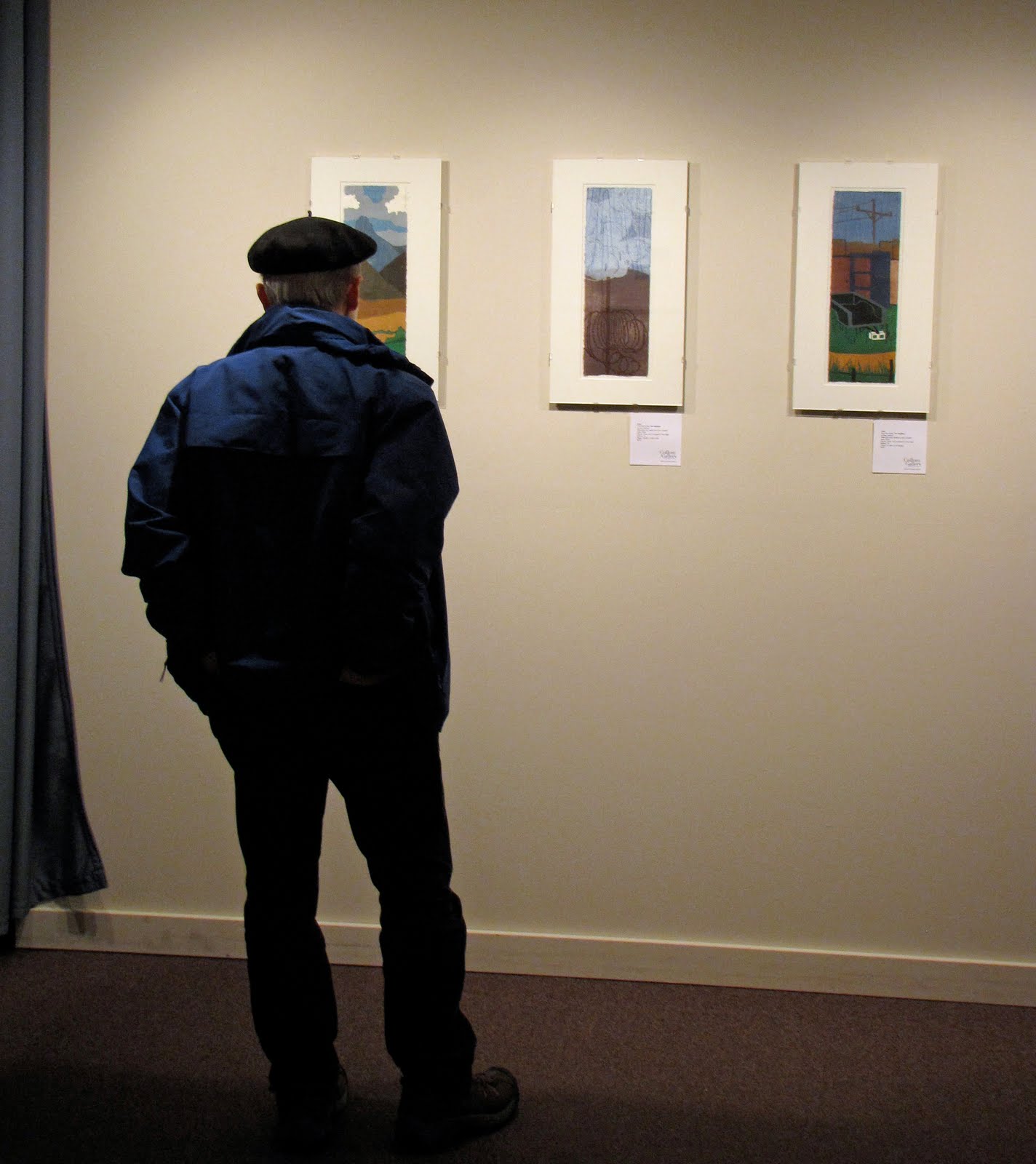
Cullom Gallery is pleased to present an exhibition of color woodcuts by Sara Tabbert. For her first show at Cullom Gallery, Tabbert has incorporated her characteristic attention to the elemental beauty in natural forms of wood, water, ice, and stone, into a new series of prints based on the artist's recent trip along the famed Great Northern Railway, nicknamed The Highline. Tabbert's series of ten reduction woodcuts considers the ‘little pieces of something’ sprinkled my human life amidst the stark topography and grandeur of America's Rocky Mountains and the Northern Great Plains.
In a nod to ukiyo-e landscape designs by Ando Hiroshige (1797-1858), Tabbert's views from Glacier Park, Montana to Fargo, North Dakota, along a well-known and linear route, recall the ukiyo-e master's Famous Views of the 53 Stations of the Tokaido Road. Also in keeping with the format of many of Hiroshige's prints, Tabbert's Highline uses the tall and narrow paper size known as tanzaku or 'poem strip' (roughly 14 x 5 inches). Whether hinting at a view through a cracked shoji screen, or capturing what the eye sees in a flash through the window of a speeding train, a landscape (by definition in the West, a horizontally-oriented view) seen in tanzaku format challenges our notions of perspective, scale, and scope, instead emphasizing the strata of a landscape's fore, mid, and background, as seen bottom to top. Born in Fairbanks, Alaska, Sara Tabbert received her Bachelor of Arts in Studio Art from Grinnell College, Iowa, and her Master of Fine Arts in Printmaking from the University of Nebraska, Lincoln, where she studied with Karen Kunc. Sara Tabbert's prints and wood carvings were showcased in the solo exhibit, Near Water, at the Anchorage Museum, from December 5, 2008 - January 25, 2009. Her prints are among public and corporate collections including the Anchorage Museum; Swedish Medical Center, Seattle; and Sheldon Memorial Art Gallery, Lincoln, Nebraska.
Just found this blog post about Meiji period monster prints. Great designs and some of the best impressions of this type of print I've seen. Here's my favorite from the post.
I'm happy to say that after a packed month of preparation during August, Cullom Gallery opened on September 4th, the fist solo of exhibit of contemporary mokuhanga (Japanese style woodblock prints) by Northampton, Massachusetts artist, Annie Bissett. I met Annie last year while searching the web for contemporary Japanese woodblock printmakers. I probably looked at the work of over 200 artists; Annie's and names of a few others made it onto one small piece of paper. What I particularly like about Annie's prints is how beautifully made they are and, in their craftsmanship, how tied they are to the tradition of Japanese printmaking, yet how different the content is! As I move further into contemporary prints, I'm not interested in prints and printmakers who are just regurgitating the hackneyed styles and subjects of 19th and 20th century Japanese prints. Japanese printmaking has a long history that includes periods of both inspired growth and predictable commercialism. Whether it's Hokusai's genius at capturing humanity and humor in his ukiyo-e, or the exciting nascent years of the sosaku hanga movement before the War, or today, printmakers like Annie Bissett, who aren't just making one more print of giant koi or thatched-roof farmhouses. These are the prints and the artists I'm after, those learning from the old tradition, but who expand upon it. In the end, these are the artist's that keep Japanese printmaking alive.
The Annie Bissett exhibit, which runs through November 1st, includes prints from 2006 to the present. It's remarkable to consider that Annie has only been making prints for three years, after taking a printmaking class with New Hampshire printmaker, Matt Brown in 2005. Prior to printmaking, Annie had spent several decades as a successful commercial illustrator with clients like the National Geographic Society, the Wall Street Journal, and the Washington Post. She continues her illustration career while working printmaking time around illustration work. Her own practice of meditation also played into the content of some of her early work, while more recent prints are driven by Annie's interest in mapping, locations, and the human impact, for better or for worse, upon a place. Earlier this year she completed a triptych called Three Prophets: tall narrow prints that start with satellite views of Bethlehem, Mecca, and Lumbini - the birth places of Jesus, Mohammed, and the Buddha. Over the maps Annie places symbols and texts that add the human layer to the place. Annie uses the same approach in another print that tells the historic tale of the U.S./Mexico border - the first of what will be a multi-print series of famous, or infamous, borders of the world. Response has to Annie's prints been great thus far. Prints from all editions are still available, though just a few are left in some cases. I'm also excited that Annie will be in Seattle for the exhibit's October 2nd reception from 6-8 pm at Cullom Gallery. She will then stick around Seattle and be back in the Gallery Saturday afternoon, October 4th for an artist's talk at the Gallery at 2 pm. Please give the Gallery a call at 206.919.8278 if you can make it, or just stop by too.
I am the Owner and Director of Cullom Gallery (603 S Main Street, Seattle, WA 98104), a Seattle art gallery,
specializing in the tradition and influence of Japanese woodblock prints & works on paper. Cullom Gallery is open Tuesday through Thursday and Saturday, from 10 to 5, and every first Thursday from 6 to 9 pm. We are also online at www.cullomgallery.com.
Megane is an outlet for exploring subjects related to Japanese prints & paper: artists, history, design, trends, exhibits, events, and musings.




 Posts
Posts

